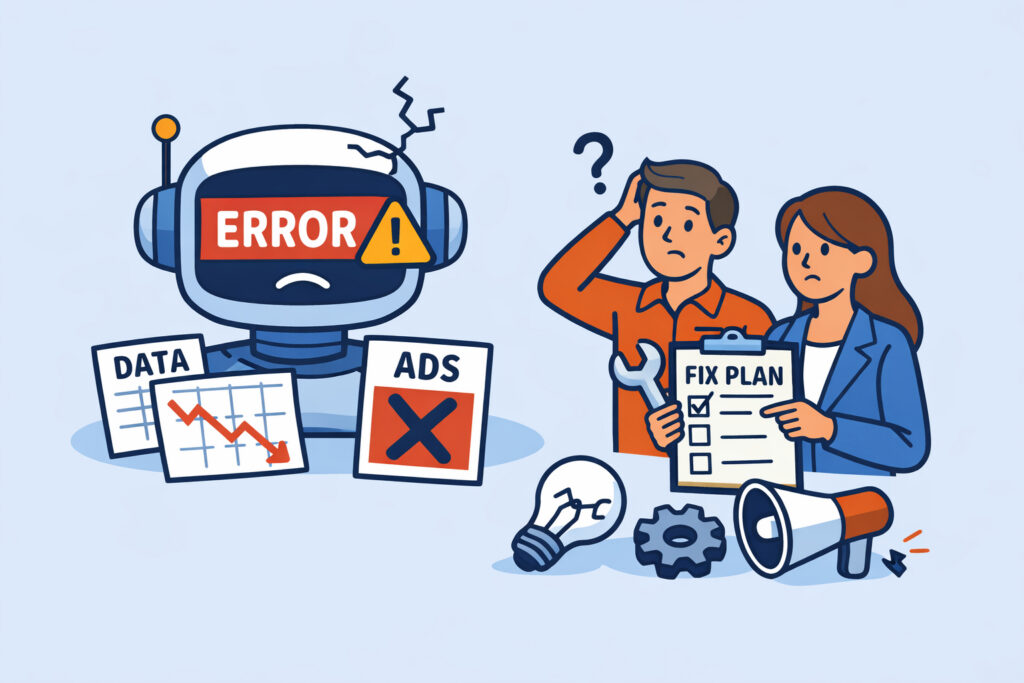
Most AI marketing tools fail not because the technology is bad – but because the implementation is. If you’ve invested in AI marketing tools expecting a revolution and got a glorified spreadsheet instead, you’re not alone. The gap between what AI promises for sales and marketing automation and what most teams actually experience is massive – and entirely fixable.
The Real Reason AI Marketing Tools Underperform
Let’s start with the uncomfortable truth: about 70–80% of AI tool adoptions in sales and marketing teams stall within the first six months. Not because the tools lack features, but because teams plug them in with no strategy, no clean data, and no defined workflow.
Here’s a scenario you might recognize. A VP of Marketing sees a demo of an AI-powered lead scoring tool. It looks incredible – predictive analytics, automatic segmentation, intent signals. The team signs a 12-month contract, connects it to their CRM, and waits for magic. Three months later, the tool is spitting out scores nobody trusts, the sales team ignores them, and the marketing ops person who was supposed to “own” it has moved on to other fires. Sound familiar?
The problem isn’t the AI. It’s the assumption that AI is a plug-and-play solution. It never is.
Five Reasons AI Marketing Tools Fail
1. Dirty or incomplete data. AI is only as smart as the data it learns from. If your CRM is full of duplicate contacts, outdated job titles, and missing fields, your AI tool will confidently make terrible decisions. Garbage in, garbage out – this old rule hasn’t changed.
2. No clear use case. “We need AI” is not a strategy. Teams that succeed define a specific, measurable problem first – like reducing lead response time from 4 hours to 15 minutes, or increasing email reply rates by 20%. Without a concrete goal, you can’t measure success or failure.
3. Tool sprawl without integration. Many teams stack five or six AI-powered point solutions that don’t talk to each other. You end up with an AI email tool, an AI ad optimizer, an AI chatbot, and an AI analytics dashboard – none sharing data, each creating its own silo.
4. Skipping the human-in-the-loop phase. The most common mistake I’ve seen is going fully autonomous too fast. AI needs a calibration period where humans review its outputs, correct mistakes, and fine-tune the system. Skip this, and you’ll automate your way into sending irrelevant messages at scale.
5. Measuring the wrong things. Teams track vanity metrics – emails sent, leads scored, content generated – instead of pipeline impact. If your AI tool generates 500 blog posts but none rank or convert, that’s not success. If it sends 10,000 emails but your reply rate drops, that’s a warning sign.
How to Fix Your AI Marketing Stack
The fix isn’t to abandon AI – it’s to implement it like a professional, not a hobbyist.
Start with one workflow, not ten. Pick the single biggest bottleneck in your sales funnel. Maybe it’s lead qualification, maybe it’s follow-up timing, maybe it’s ad spend waste. Solve that one problem with AI first. Get it working, get the team trusting it, then expand.
Clean your data before you connect anything. Spend two weeks auditing your CRM. Merge duplicates, standardize fields, remove dead contacts. This unglamorous work will 10x the effectiveness of any AI tool you plug in afterward.
Integrate, don’t accumulate. Choose tools that connect natively to your existing stack – your CRM, your email platform, your ad accounts. One well-integrated AI system will outperform five disconnected ones every time. If you’re running Google Ads, for example, an AI optimization layer that feeds conversion data back into your CRM and cuts your ad spend by 40% is worth more than three standalone dashboards.
Set a 90-day calibration period. For the first three months, treat AI outputs as suggestions, not commands. Have your team review lead scores, check email drafts, and validate ad recommendations. Track where the AI is right and where it’s off. Adjust thresholds and rules accordingly. After 90 days, you’ll have a system you can trust – and data to prove it.
Measure pipeline, not activity. The only metrics that matter are revenue-adjacent: qualified leads generated, pipeline velocity, conversion rate improvements, cost per acquisition changes. Everything else is noise.
Myth: AI Replaces Your Marketing Team
This is the biggest misconception holding teams back. AI doesn’t replace marketers or salespeople – it removes the repetitive, low-value work that burns them out. Your best salesperson shouldn’t spend 40% of their day on data entry and follow-up scheduling. AI handles that, so your people can focus on relationship building, creative strategy, and closing deals.
The teams getting real results from AI aren’t the ones with the biggest tech budgets. They’re the ones who treat AI as a force multiplier for their existing talent – not a replacement.
What a Properly Implemented AI Marketing System Looks Like
When it works, the difference is dramatic. A typical B2B team running a well-integrated AI marketing stack sees lead response times drop from hours to minutes, email personalization that actually references relevant pain points instead of “Hi {FirstName}”, ad spend that self-optimizes weekly instead of quarterly, and a sales pipeline where reps know exactly which leads to call first and why.
The ROI timeline is usually 60–90 days for the first measurable wins, and 6 months for full system maturity. That’s not overnight, but it’s fast enough to justify the investment – if you do it right.
FAQ
How much should an SMB budget for AI marketing tools?
Most SMBs can start effectively with $200–$500 per month in tooling costs. The bigger investment is time – expect 10–15 hours per week during the first month for setup, data cleaning, and calibration. After that, ongoing maintenance drops to 2–3 hours per week.
Can AI marketing tools work without a large contact database?
Yes, but your approach changes. With smaller databases (under 5,000 contacts), AI excels at personalization and timing optimization rather than predictive scoring. Focus on making every touchpoint count instead of trying to find statistical patterns in limited data.
What’s the first AI tool a sales team should implement?
Start with AI-powered email sequencing and follow-up automation. It’s the fastest path to measurable results because it directly impacts response rates and pipeline velocity – and it forces you to clean your CRM data, which benefits everything else you add later.
The bottom line: AI marketing tools don’t fail because AI doesn’t work. They fail because teams skip the fundamentals – clean data, clear goals, proper integration, and realistic timelines. Fix those, and the same tools that disappointed you before will start delivering the results you expected all along.