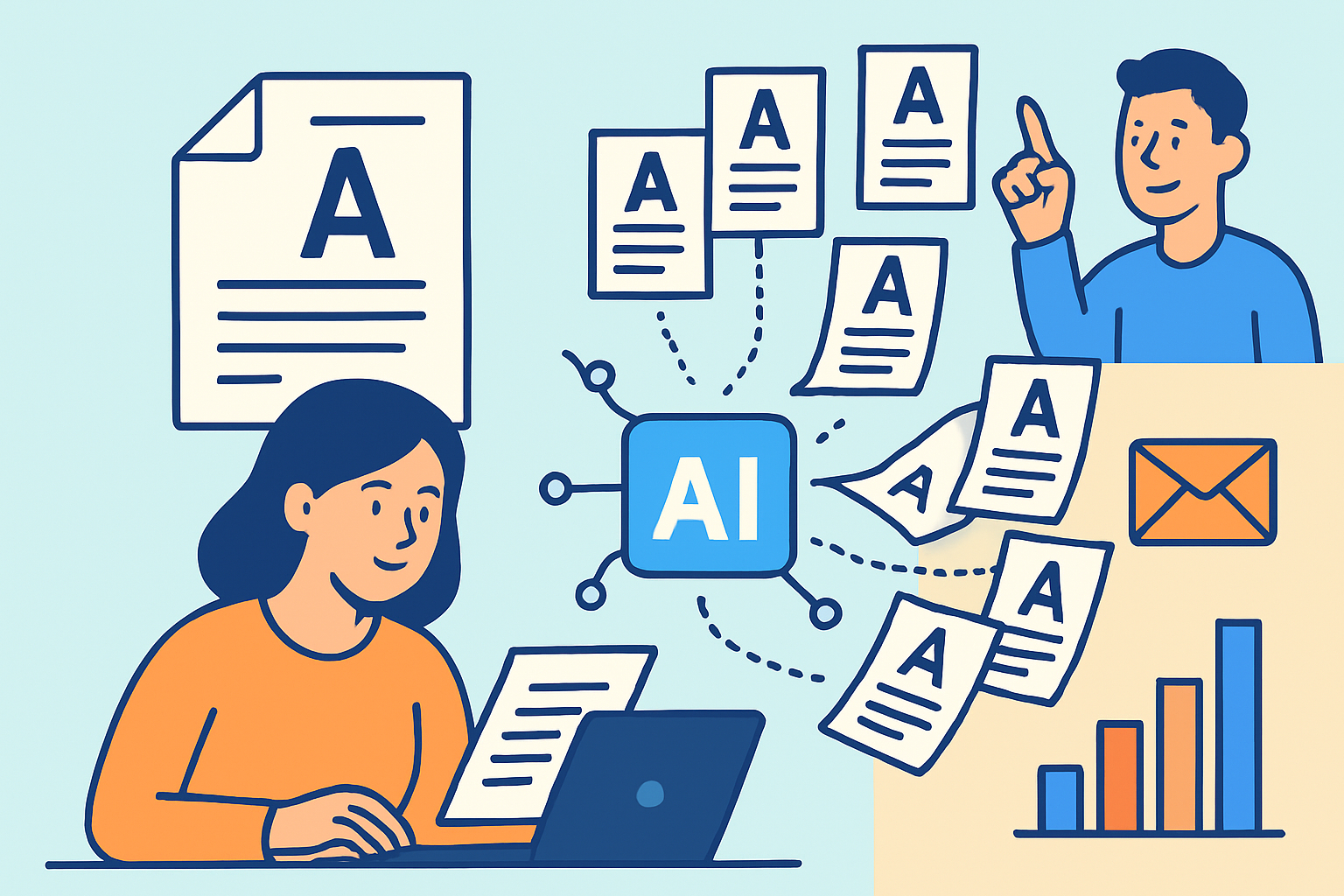
Content repurposing with AI has gone from a marketing team’s pipe dream to a practical weekly workflow. If you’re spending three hours writing a blog post and getting one use out of it, you’re leaving significant pipeline value behind.
Why Most Teams Waste 80% of Their Content Investment
A typical B2B marketing team publishes an article, shares it once on LinkedIn, maybe drops it in a newsletter, and moves on. The article cost real time – research, writing, editing, approval – but it only reached a fraction of the audience that could benefit from it.
The problem isn’t the content itself. It’s the distribution model. Different buyers consume content in completely different formats: some read long articles, others only engage with short social posts, and a growing segment relies almost entirely on short-form video or audio. One format simply can’t reach all of them.
What “Ten Pieces” Actually Looks Like
Starting from a single 1,000-word article, here’s what can realistically be extracted:
1. The original article (your cornerstone piece)
2. A LinkedIn carousel breaking down the key framework
3. Three to five standalone social posts – each built around a single insight
4. A short-form video script for Reels or TikTok
5. A newsletter section or dedicated email
6. A thread for X (formerly Twitter)
7. A condensed version for a sales email sequence
8. A podcast talking points outline
9. A FAQ document for the sales team
10. A slide deck for a webinar or internal training
Not every format works for every article. A highly technical how-to guide translates differently than a thought leadership piece. But the raw material is already there – AI just removes the manual effort of repackaging it.
The Step-by-Step Repurposing Workflow
The process works cleanest when it follows a defined sequence rather than ad hoc requests to an AI tool.
Step 1 – Tag the core ideas. Before sending the article to any AI system, identify the two or three main takeaways. These become the anchor points for every derivative piece. Without this step, AI tends to produce generic summaries rather than content with a clear angle.
Step 2 – Generate format-specific prompts. Feed the article to your AI tool with explicit instructions for each output. “Write a 10-slide LinkedIn carousel based on this article, with each slide focused on one actionable point” produces much better results than “summarize this for LinkedIn.”
Step 3 – Edit for voice and context. AI drafts need human review. A newsletter reader expects a different tone than a LinkedIn audience, and a sales email has a different job than a blog post. Budget 10–15 minutes per format for light editing rather than full rewrites.
Step 4 – Schedule in batches. Use a content scheduling tool to distribute the pieces across two to three weeks. Spacing the content out extends the lifespan of a single article and prevents audience fatigue from seeing the same message five times in one day.
Where AI Saves the Most Time
The biggest time sink in traditional repurposing isn’t the writing itself – it’s the reformatting. Turning a 900-word article into a 10-slide carousel requires restructuring the entire argument. Condensing it into a short tweet requires distilling one idea from many. AI handles both in under a minute.
Teams that run this workflow consistently report cutting their content production time in half while doubling the number of active distribution channels. A content manager who previously spent 40% of their week writing net-new content can shift much of that capacity to strategy and optimization. Scaling content production without quality loss depends almost entirely on having repeatable systems – and AI-assisted repurposing is one of the highest-leverage ones available.
The Myth That Repurposed Content Looks Lazy
A persistent misconception is that audiences can “tell” when content is repurposed and will disengage. In practice, most people never saw your original article. The LinkedIn follower who engages with your carousel may never visit your blog. The newsletter subscriber who clicks through probably didn’t see the social posts.
Each channel has a largely separate audience. Repurposing isn’t repetition – it’s reaching the right person on the channel they actually use. The only case where it becomes a problem is when teams copy-paste content directly without adapting it for context, tone, or format. AI makes it easy to do the adaptation correctly the first time.
Practical Tips for Getting Started
Start with your three to five highest-performing existing articles. These already have proven engagement, which means the underlying ideas resonate – AI can extend their reach without requiring you to validate the topic again.
Use a structured prompt template for each content format and save it as a reusable workflow in your tool of choice. This removes the guesswork from each session and keeps outputs consistent across team members.
Don’t try to produce all ten formats at once. Start with two or three – usually a LinkedIn post, a short email version, and a social thread – then expand the workflow as you build confidence in the outputs.
Frequently Asked Questions
Does AI repurposing work for technical B2B content?
Yes, but it requires more specific prompting. For technical content, include explicit instructions about the audience’s knowledge level and the desired depth. AI tends to oversimplify technical material unless guided otherwise. Reviewing the output against the source article before publishing is especially important here.
How many times can one article realistically be repurposed?
Most articles can support eight to twelve derivative pieces before the content feels exhausted. The limiting factor is usually the number of distinct insights in the original – a generic overview piece yields fewer strong derivatives than an article with a clear framework, concrete data, or a counterintuitive argument.
Do repurposed pieces hurt SEO?
Social posts, email content, and internal documents don’t create duplicate content issues. For web-published formats like landing pages or additional articles derived from the same source, light editing and distinct angles are enough to differentiate them. AI makes this differentiation straightforward.
Making Repurposing a Repeatable System
The teams that get the most from content repurposing with AI aren’t doing it occasionally – they’ve built it into their production workflow. Every article that gets published triggers the same sequence: tag the key ideas, run the format prompts, edit and schedule.
Over time, this builds a content engine where one hour of original writing generates two to three weeks of distribution. That’s the real leverage AI offers in content operations – not replacing the thinking, but eliminating the manual work that sits between a good idea and the audiences who need to hear it.