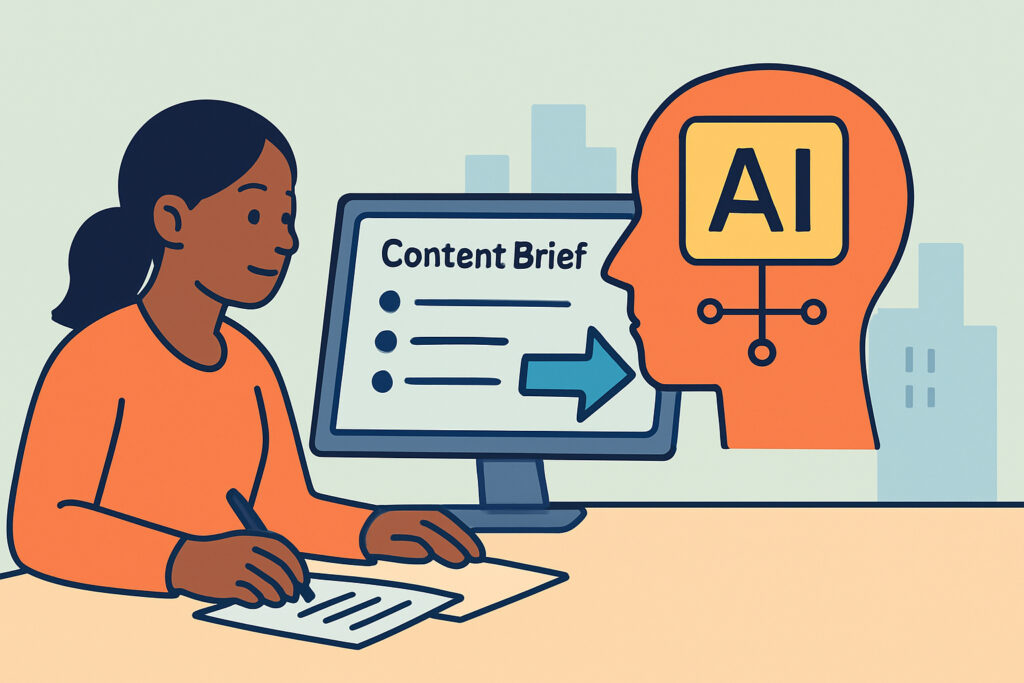
A content brief decides most of the quality of an AI draft before the first prompt runs. If your team produces blog posts, landing pages, or nurture emails with ChatGPT, Claude, or Jasper and keeps getting flat, generic drafts, the model is usually not the problem. The input is. This article covers what a strong content brief contains, how to build one in under an hour, and which mistakes waste the most editing time.
A good brief has a direct payoff: fewer rewrite rounds, drafts that match search intent, and content that moves readers toward a sales conversation instead of just filling a publishing calendar.
Why AI Drafts Fail Before Writing Starts
Large language models predict the most likely next sentence. Give one a topic and a word count, and it returns the most average version of that topic on the internet. That is exactly what ranks poorly and converts worse.
A brief replaces “average” with specifics. It tells the model who is reading, what they already know, which angle the piece takes, and what the reader should do next. Without that context, the model fills the gaps with safe generalities.
Here is a scenario most marketing leads will recognize. A team publishes eight AI-assisted articles a month. Each draft takes an editor 3-4 hours to fix, because the tone is wrong, the examples are vague, and the call to action is tacked on at the end. The team adds structured briefs. Editing time drops to about 60-90 minutes per piece, mainly because the editor now refines a draft instead of rebuilding it. Writing the brief takes about 45 minutes. The net saving is still roughly two hours per article.
What a Content Brief for AI Needs to Include
A brief written for a human freelancer can be loose, since a good writer asks questions. A model doesn’t ask questions. It guesses. That means a content brief for AI has to be more explicit than most teams are used to.
A content strategist building one starts with the reader, not the keyword. The brief names the role (a VP of Sales at a 50-200 person SaaS company, for example), their current problem, and their level of knowledge. “Marketers” is too broad to steer a model. “Demand gen managers who already run HubSpot workflows but have never used lead scoring” gives it something to work with.
Next comes search intent and angle. Pull the top 5-10 ranking pages for the target keyword in Ahrefs or Semrush and note what they all cover. Your brief then states two things: the subtopics that are table stakes, and the one angle competitors miss. That second item is where the article becomes worth reading.
The brief must also carry the inputs the model can’t invent. That means your own numbers, customer objections from sales calls, product constraints, and real examples. A model can phrase an insight well. It cannot know that your average sales cycle is 47 days or that prospects keep asking about Salesforce migration.
Finally, define the structure and the conversion goal: the H2 outline, target length, internal links, and the specific next step for the reader. Voice rules belong here too, or in a shared document the brief points to. Our article on editorial guardrails for AI output covers that layer in more depth.
Building the Brief Step by Step
A practical process takes 30-60 minutes per article once the template exists:
1. Define the reader and the job. One sentence on who they are and one on what they need to decide.
2. Audit the SERP. Review the top-ranking pages and list shared subtopics and gaps. Clearscope, Surfer SEO, or Frase can speed this up, at roughly $100-200/month for entry plans.
3. Add proprietary material. Paste in call notes from Gong, support tickets, or CRM data that only your company has.
4. Lock the outline. Write every H2 yourself. Let the model fill sections, not invent the structure.
5. State the conversion path. Name the next action and the objection the article has to handle before the reader takes it.
The order matters. Teams that start with step 4 tend to end up with outlines copied from competitors, because they never checked what was missing.
The Myth: Better Prompts Beat Better Briefs
A popular belief holds that prompt engineering is the skill that matters, and that clever phrasing like “act as a world-class copywriter” unlocks better output. It doesn’t, at least not in any way that lasts.
Role prompts and formatting tricks change style a little. They don’t add information. A model told it is an expert in B2B lead generation still knows nothing about your ICP, pricing, or why your last three deals stalled. The brief carries the information. The prompt is only the wrapper.
This becomes obvious when teams switch models. A strong brief produces usable drafts in GPT-4o, Claude, or Gemini. A weak brief with a polished prompt produces generic drafts in all three.
Common Mistakes That Waste Editing Time
The most expensive mistake is briefing on keywords instead of questions. A brief that lists 25 NLP terms from an optimization tool produces text stuffed with those terms and no clear argument. Keyword lists help with coverage, but the brief has to state the question the article answers first.
The second is leaving out what not to say. Models drift toward claims your sales team can’t back up, competitor comparisons legal hasn’t approved, or features on next quarter’s roadmap. One line listing off-limits claims prevents most of these problems.
The third is measuring the wrong output. Teams track drafts produced per week and treat a faster pipeline as success. The metric that matters is editing time per published piece, along with conversions from that content. Ten drafts that each need a full rewrite are worse than four that ship nearly as written.
When the Standard Approach Doesn’t Fit
Regulated industries such as healthcare, financial services, and insurance need an extra review layer that no brief replaces. In those cases the brief should include approved claim language word for word, and compliance should sign off on the template itself, not just each article.
Teams under 10 people often over-engineer this. A one-page template with five fields beats a 3-page brief nobody fills in. Content for non-English-speaking markets needs separate briefs written by someone who knows local search behavior, because translating an English brief carries over the wrong intent.
FAQ
How long should a content brief be?
For a 1,000-1,500 word article, 300-600 words of brief is usually enough. A longer brief helps only when the added material is original data or examples, not repeated instructions.
Can AI write the content brief itself?
Partly. AI can summarize SERP research and draft an outline. The reader definition, proprietary insights, and conversion goal should come from someone who talks to customers, or the brief will be as generic as the draft it produces.
Do content briefs matter for short-form content like emails and ads?
Yes, and arguably more. With 50-150 words there is no room to recover from the wrong angle, so audience, offer, and objection need to be set before anything is generated.
Make the Brief the Asset
Treat the brief as the real work product and the AI draft as its output. Build one template, test it on three articles, and track editing time before and after. If editing time doesn’t drop by at least a third, the brief is missing context the model needs, and most of the time that missing piece is something only your sales and customer conversations can supply.