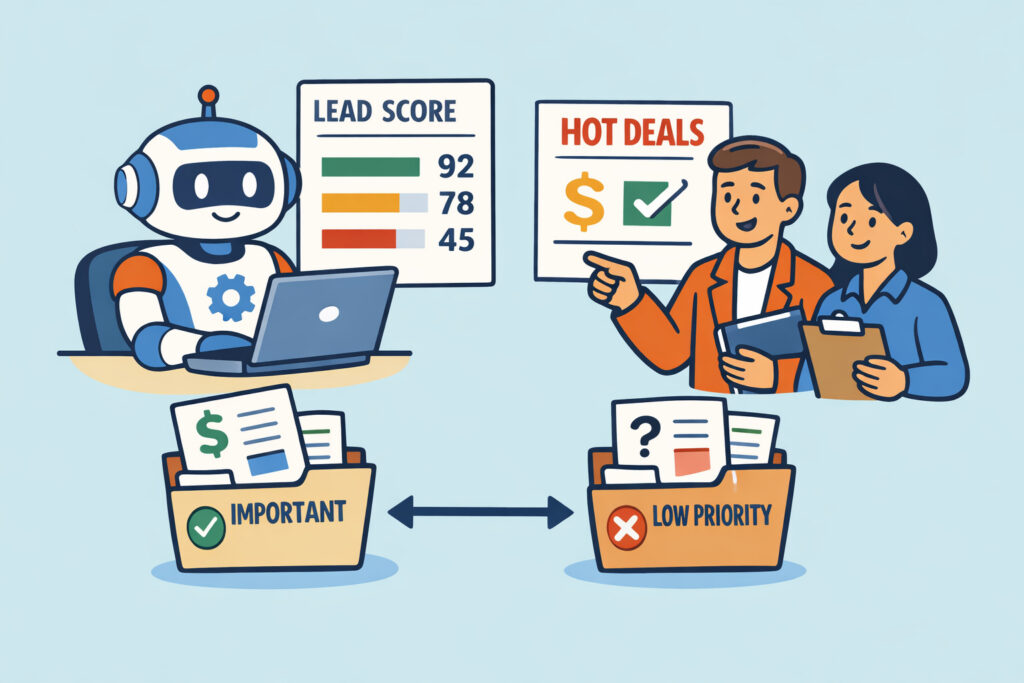
AI lead scoring helps sales teams stop wasting time on leads that were never going to buy – and start putting energy into the deals that actually move. If your reps are still working every lead the same way, you’re leaving revenue on the table.
Most sales teams have more leads than they can handle. The problem isn’t volume – it’s prioritization. Traditional lead scoring, where marketing assigns points based on job title or email opens, barely scratches the surface. AI lead scoring uses behavioral data, engagement patterns, and historical win/loss signals to rank leads by real purchase intent. The result: your team talks to fewer people but closes more deals.
Why Traditional Lead Scoring Falls Short
If you’ve ever had a “hot lead” with a VP title who ghosted after the first call, you already know the problem. Traditional scoring systems are built on assumptions – that seniority equals buying power, or that downloading a whitepaper means someone’s ready to buy.
These systems are static. They don’t learn. A lead who matches your ideal customer profile on paper but has zero engagement momentum gets the same score as someone who’s visited your pricing page three times this week. That’s a problem your reps feel every single day when they pick up the phone.
The real cost isn’t just missed deals. It’s rep burnout. When 60–70% of the leads in your pipeline go nowhere, motivation drops fast.
How AI Lead Scoring Actually Works
AI lead scoring isn’t magic – it’s pattern recognition at scale. Here’s what happens under the hood:
Data collection. The system pulls signals from your CRM, email engagement, website behavior, social interactions, and even third-party intent data. Every touchpoint contributes to the picture.
Model training. The AI analyzes your closed-won and closed-lost deals to find what separates buyers from browsers. Maybe it’s the combination of visiting the pricing page, opening three emails in a week, and coming from a company with 50–200 employees. A human would never spot that pattern across thousands of records.
Dynamic scoring. Unlike static point systems, AI scores update in real time. A lead that was cold last Tuesday can jump to the top of the list after engaging with a case study and requesting a demo. Your reps see the shift immediately.
Continuous learning. Every closed deal – won or lost – feeds back into the model. The scoring gets sharper over time, not stale.
The Myth: You Need Perfect Data to Start
This is the biggest misconception holding teams back. “Our CRM is a mess, so we can’t do AI scoring yet.” Heard it a hundred times.
The truth is, you don’t need perfect data – you need enough data. If you have 6–12 months of deal history with clear outcomes (won, lost, stalled), most AI scoring tools can work with that. The model doesn’t need every field filled in perfectly. It finds signal in the noise. That’s literally the point.
Start with what you have. Clean up the obvious gaps – make sure deal outcomes are marked, and that basic contact and company info is there. You can refine as you go. Waiting for perfect data means waiting forever.
Practical Steps to Implement AI Lead Scoring
Step 1: Audit your current pipeline. Pull your last 12 months of closed deals. Tag them as won, lost, or no-decision. Look at your conversion rate from MQL to closed-won – that’s your baseline.
Step 2: Choose the right tool for your stack. If you’re on HubSpot or Salesforce, both offer native AI scoring features. Standalone tools like MadKudu or Clearbit can layer on top of almost any CRM. The key question: does it integrate cleanly with your existing workflow, or does it create another tab your reps will ignore?
Step 3: Define your scoring tiers. Don’t overcomplicate it. Three tiers work for most teams – high priority (work immediately), medium (nurture sequence), and low (marketing keeps warming). Make sure reps know exactly what action to take for each tier.
Step 4: Run a parallel test. Keep your old scoring running alongside the AI model for 30–60 days. Compare which system better predicts actual closes. This builds trust with the sales team – they’ll see the difference in their own numbers.
Step 5: Review and recalibrate quarterly. Markets shift. Buyer behavior changes. Set a calendar reminder to review model performance every quarter. Are the high-priority leads still converting at a higher rate? If not, retrain the model.
What Results to Expect – Realistically
Teams implementing AI lead scoring typically see a 20–35% improvement in sales efficiency within the first quarter. That doesn’t mean 35% more revenue overnight – it means reps spend more time on winnable deals and less time chasing dead ends.
One pattern that shows up consistently: the mid-funnel speeds up. Deals that used to sit in “evaluating” for weeks get attention earlier because the AI flagged buying signals the rep would have missed. Pipeline velocity improves before raw close rates do – and that’s actually the healthier leading indicator.
If you’re running paid acquisition alongside AI scoring, the combination gets powerful fast. You’re not just generating better leads – you’re routing them to reps at exactly the right moment.
FAQ
How is AI lead scoring different from predictive lead scoring?
Predictive lead scoring is actually a subset of AI scoring. The difference is scope – predictive models typically focus on fit-based data (company size, industry, role), while modern AI scoring adds real-time behavioral signals like email engagement, website visits, and content consumption patterns. The combination of fit and behavior is what makes AI scoring significantly more accurate.
Can AI lead scoring work for small sales teams?
Yes – and arguably it matters more for small teams. When you only have 3–5 reps, every hour counts. AI scoring ensures those limited hours go to the highest-value conversations. You don’t need enterprise budgets either; tools like HubSpot’s built-in scoring are included in mid-tier plans.
How long does it take to see results?
Most teams need 30–60 days to run a proper parallel test and start trusting the scores. Measurable pipeline impact – faster deal velocity, higher conversion from scored leads – typically shows within one full sales cycle, which is 60–90 days for most B2B teams.
The Bottom Line
AI lead scoring isn’t about replacing your sales team’s judgment – it’s about giving them better information faster. The reps who close the most deals aren’t necessarily working the hardest. They’re working the smartest leads. AI just makes sure those leads are at the top of the list every morning.
Stop treating every lead like it deserves equal effort. Some leads are ready to buy. Find them first.