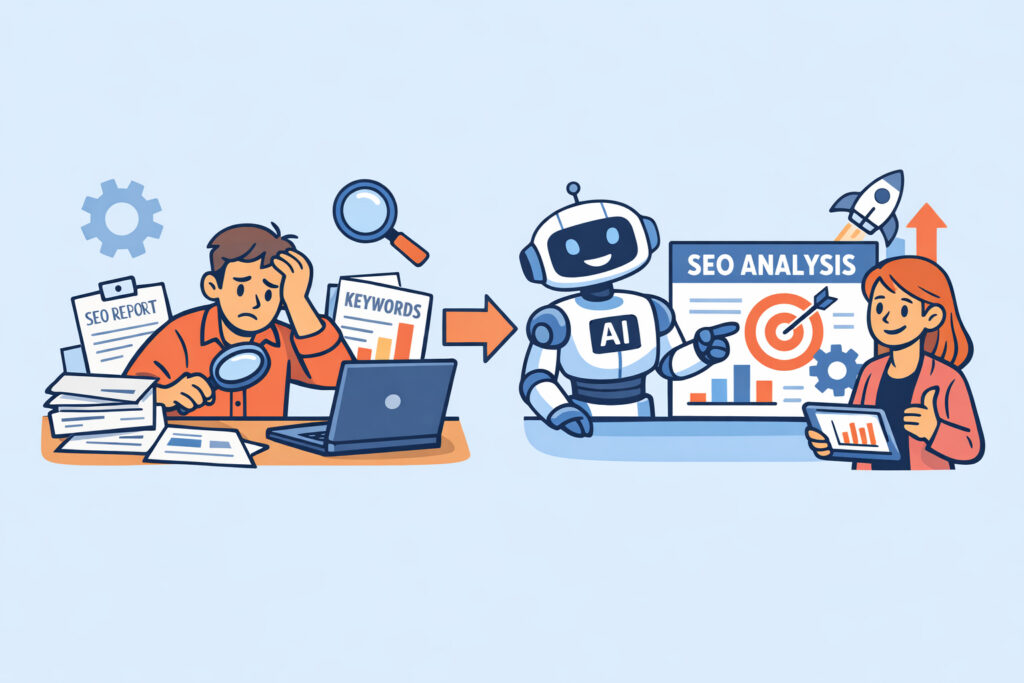
If you’re still spending hours manually researching keywords, writing meta descriptions one by one, and tweaking title tags in a spreadsheet, AI is already doing it faster – and often better. AI is replacing manual SEO across nearly every workflow that used to eat up your week, from content planning to technical audits. The question isn’t whether to adopt it – it’s how fast you can make the switch without losing what actually works.
The manual SEO grind is dying – here’s why
Think about what a typical SEO workflow looked like even two years ago. You’d pull keyword data from one tool, cross-reference search volumes in another, manually cluster topics in a spreadsheet, brief a writer, wait for a draft, edit it, optimize it, publish it, then check rankings three months later. That’s a lot of human hours for a process that’s fundamentally about pattern recognition – exactly the kind of work AI handles well.
Today, AI tools can do keyword research, content clustering, SERP analysis, on-page optimization, and even technical crawl interpretation in a fraction of the time. Teams that used to need a dedicated SEO analyst for content planning alone are now running the same output with a marketing generalist and the right AI stack.
This doesn’t mean SEO expertise is worthless. It means the type of expertise that matters has shifted – from execution to strategy.
What AI actually does better than humans in SEO
Let’s be specific. AI outperforms manual work in these areas right now:
Keyword research and clustering. AI can analyze thousands of keywords, group them by intent, and map them to content topics in minutes. What used to take a strategist half a day now takes a prompt and a review pass.
Content optimization. Tools powered by large language models can suggest heading structures, internal link opportunities, keyword placement, and readability improvements while you write – or after the fact.
Technical audits. Crawling a site for broken links, duplicate content, thin pages, and schema issues is tedious manual work. AI-assisted crawlers flag issues and even prioritize fixes by estimated traffic impact.
SERP analysis. Instead of manually reviewing the top ten results for a keyword, AI can extract patterns across hundreds of SERPs – common subtopics, content length, heading structures, featured snippet formats – and give you a brief in seconds.
Reporting. Pulling data from Search Console, cleaning it, and spotting trends? AI handles that loop far more efficiently than copy-pasting into Google Sheets every Monday morning.
The myth: AI will fully automate SEO
Here’s the misconception that gets people in trouble – the idea that you can just plug in an AI tool and forget about SEO entirely. That’s not how it works, and teams that try it usually end up with a blog full of generic, surface-level content that ranks for nothing.
AI is excellent at processing data and generating drafts. It’s not great at understanding your specific market positioning, your customer’s real objections, or the nuance that turns a decent article into one that actually converts. I’ve seen companies generate 50 AI-written articles in a month and watch their organic traffic flatline – because the content had no depth, no unique angle, and no internal linking strategy behind it.
The teams winning at SEO right now use AI for the heavy lifting and keep human judgment for strategy, differentiation, and quality control. That’s the combination that works.
What to do about it – a practical playbook
If you’re a sales or marketing leader wondering how to adapt, here’s a realistic approach:
Audit your current SEO workflow. List every recurring task – keyword research, content briefs, writing, optimization, reporting, link building outreach. Mark which ones are mostly manual pattern-matching (those go to AI first) and which require strategic thinking (those stay human-led).
Pick one AI tool per workflow stage. Don’t try to overhaul everything at once. Start with the biggest time sink. For most teams, that’s content production or keyword research. Get one workflow running smoothly before expanding.
Build a human review layer. Every AI-generated output – whether it’s a content brief, a draft, or an audit report – needs a human check. Not because AI is unreliable, but because your competitive advantage comes from the expertise and context you add on top.
Shift your team’s skills. Train your SEO people to become AI operators, not just analysts. The most valuable skill in SEO today is knowing how to prompt, evaluate, and refine AI outputs – not how to manually pull data from five different dashboards.
Measure what matters. Don’t just track rankings. Track the efficiency of your pipeline – how much content you produce per hour, how fast you go from keyword research to published page, and ultimately how that content drives leads and revenue.
Where human expertise still wins
AI can’t sit in a sales call and hear the exact words a prospect uses to describe their pain. It can’t look at your competitor’s positioning and decide how to differentiate. It can’t tell you which of your ten product pages should be the pillar and which should be supporting content based on your business goals – not just search volume.
Strategy, brand voice, customer empathy, and cross-functional alignment – these are the areas where experienced marketers and salespeople still add irreplaceable value. The smart move is to free up time for exactly this kind of work by handing the repetitive tasks to AI.
FAQ
Will AI-generated content get penalized by Google?
Google has stated that it focuses on content quality, not how the content was produced. AI-generated content that’s helpful, accurate, and well-structured can rank just fine. The risk isn’t in using AI – it’s in publishing low-effort, unreviewed output at scale.
Do I still need an SEO specialist if I use AI tools?
Yes – but the role changes. You need someone who understands search strategy, can interpret AI outputs critically, and knows how to connect SEO efforts to business outcomes. The specialist becomes more of a strategist and less of a technician.
What’s the fastest way to start using AI for SEO?
Start with content optimization on your existing pages. Run your top 20 pages through an AI optimization tool, implement the suggestions, and measure the impact over 60–90 days. It’s low risk, high learning, and often delivers quick wins.
The bottom line
AI isn’t replacing SEO – it’s replacing the manual, repetitive parts of SEO that never should have taken this long in the first place. The marketers and sales leaders who adapt fastest will spend less time in spreadsheets and more time on the strategic work that actually moves the needle. Start small, keep human judgment in the loop, and treat AI as the execution engine behind a smarter content and search strategy. That’s how you stay ahead.