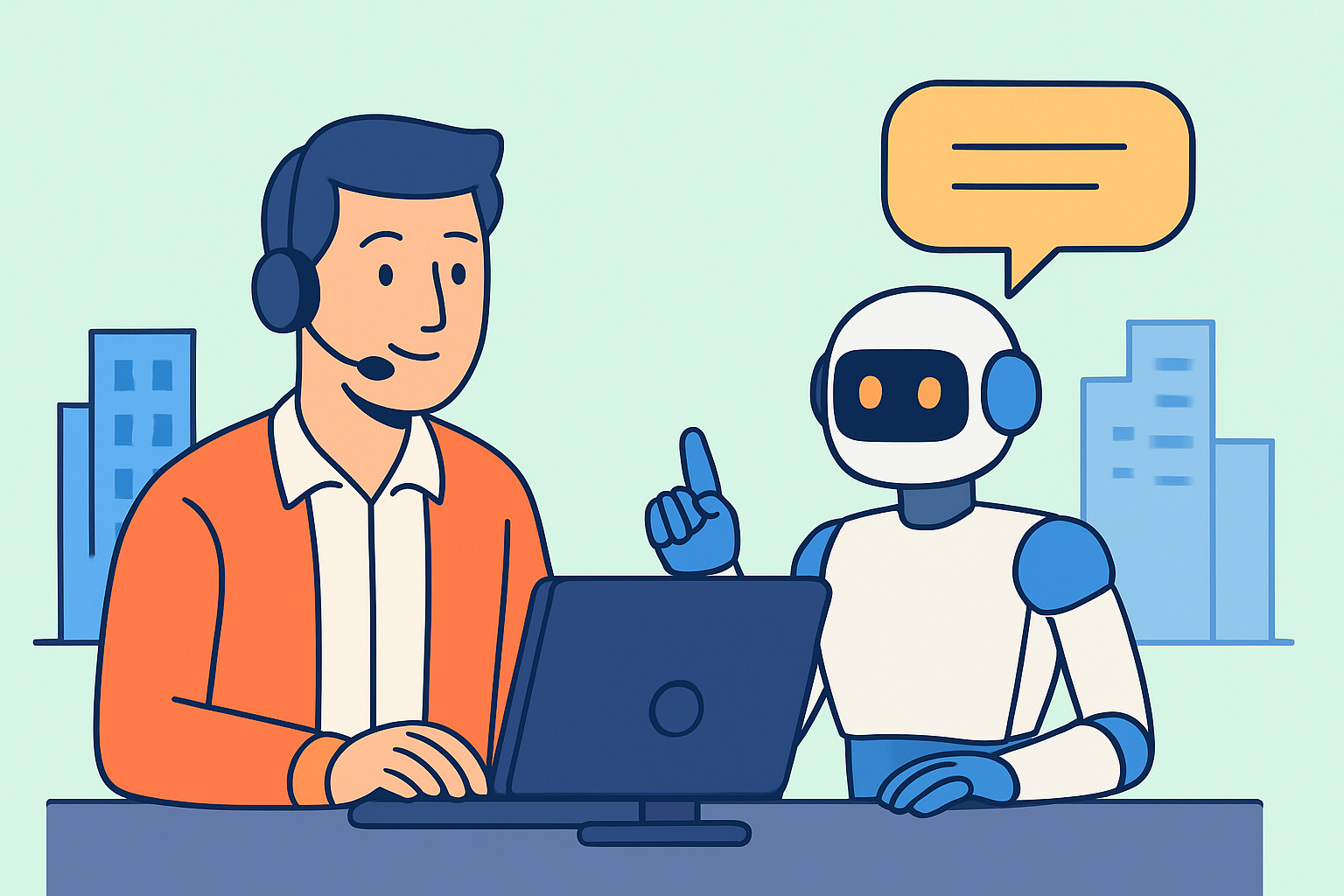
Sales development has quietly become one of the most automated corners of B2B revenue teams, and that’s forcing a hard question: should an SDR team be run by people, by software, or by some blend of the two. The honest answer, based on what actually closes deals versus what just fills a CRM with noise, is that the best-performing outbound teams right now split the work deliberately – AI handles volume and pattern-matching, humans handle judgment and relationship-building. Get that split wrong in either direction and pipeline quality suffers.
What “half human, half AI” actually means in practice
This isn’t about buying a chatbot and calling it a day, and it isn’t about resisting automation out of loyalty to “the human touch.” It’s a division of labor based on what each side is actually good at.
AI is good at repetitive, data-heavy tasks: researching accounts, drafting first-pass outreach, scoring leads, following up on schedule, and flagging buying signals across hundreds of accounts at once. Humans are good at reading a prospect’s tone in a reply, adjusting a pitch mid-conversation, handling objections, and building the kind of trust that gets a skeptical VP on a call.
A common mistake is assuming this split happens naturally once a team adopts a few tools. It doesn’t. Without a defined handoff point, AI tools end up either doing too much – sending generic sequences that damage the brand – or too little, buried under manual approval steps that erase the time savings.
Where AI should own the process
Certain SDR functions are almost entirely mechanical, and treating them as such frees up rep time for the parts that actually require a person.
Prospect research and enrichment. Pulling firmographic data, tech stack signals, recent funding news, and job changes is pure pattern-matching. AI does this in seconds across thousands of records; a rep doing it manually might get through twenty accounts a day.
First-touch outreach at scale. Initial emails and LinkedIn messages built on researched context can be generated and sent automatically, then refined based on reply rates. This is where a lot of teams struggle because “personalized at scale” still sounds like a contradiction – it isn’t, once the underlying data feeding the message is genuinely specific rather than a mail-merge trick. A closer look at how this works in practice is covered in this breakdown of outreach automation and personalized email at volume.
Lead scoring and prioritization. AI models that track engagement patterns – email opens, page visits, content downloads – consistently outperform gut-feel prioritization. Reps who trust a well-built score spend their calling time on the 20% of leads that actually convert instead of working a list top to bottom.
Sequence follow-ups and re-engagement. Automated nurture steps for leads that go quiet keep the pipeline warm without eating a rep’s calendar.
Where a human needs to stay in the loop
The moment a prospect replies with a real question, objection, or sign of genuine interest, AI’s usefulness drops sharply. This is the handoff point that separates teams getting real ROI from teams that just automated their spam output.
Discovery calls, objection handling, and negotiation still require a human who can pick up on hesitation in someone’s voice or adjust an offer on the fly. No current AI model reliably replicates that in a live conversation, and pretending otherwise usually shows up in the numbers – lower show rates, more ghosting after the first call, deals that stall for reasons nobody can quite name.
Multi-threading into an account – getting buy-in from a champion, a budget holder, and an end user – also depends on relationship judgment that AI can support with data but shouldn’t run unsupervised. A rep needs to decide who to loop in and when, based on subtle cues in how each stakeholder is engaging.
A realistic scenario
A 12-person SDR team running a mix of outbound and inbound qualification typically spends the majority of its week on research, list-building, and unanswered sequences – not on live conversations. Shift the research, enrichment, and first-touch sequencing to AI, and reps get back several hours a day that used to go into manual prospecting.
The catch, and this is the mistake that trips up most rollouts: reps need new triggers for when to jump in. Without a clear rule – say, any reply that isn’t a flat “not interested,” or any lead crossing a defined engagement score – AI-qualified leads sit untouched, or worse, reps duplicate the AI’s early-stage outreach out of habit. The teams that get this right build a routing rule directly into their CRM so qualified conversations land in a rep’s queue automatically. That kind of routing logic is worth building deliberately rather than bolting on later, and it connects directly to how a lead qualification engine should actually be structured.
The myth worth busting
A persistent misconception is that AI SDRs are meant to replace headcount outright. In practice, the teams seeing the strongest pipeline growth aren’t shrinking their SDR headcount – they’re redeploying it. Reps who used to spend four hours a day on manual list-building now spend that time on calls, and quota attainment tends to improve because the volume of qualified conversations goes up, not because fewer people are involved.
The inverse myth is just as damaging: that AI outreach is inherently spammy and should be avoided. Poorly built sequences are spammy regardless of who wrote them. A generic template blasted to a purchased list is bad whether a human or a script sent it. The differentiator is data quality and relevance, not the presence of automation.
Common questions
Does adding AI to an SDR team reduce the need for reps?
Not typically. It changes what reps spend their time on. Most teams that automate research and first-touch outreach redirect rep hours toward live conversations and deal progression rather than cutting positions, since qualified conversation volume usually increases.
How do you decide when AI should hand off a lead to a human?
Define the trigger before rollout – a specific reply type, an engagement score threshold, or a direct meeting request. Leaving the handoff vague is the most common reason hybrid SDR programs underperform.
Can AI-generated outreach actually feel personal?
Yes, but only if it’s built on real account-specific data rather than name-and-company mail-merge fields. Messages referencing a recent funding round, a specific job posting, or a tech stack detail perform very differently than generic templates, even when both are technically “automated.”
The takeaway
Treating AI and human reps as competitors misses the point. The teams pulling ahead in outbound right now are the ones that mapped their SDR process step by step and assigned each part to whichever side – software or person – does it better. Start with research and first-touch, keep humans on discovery and negotiation, and build a clear handoff in between. That’s the whole model.