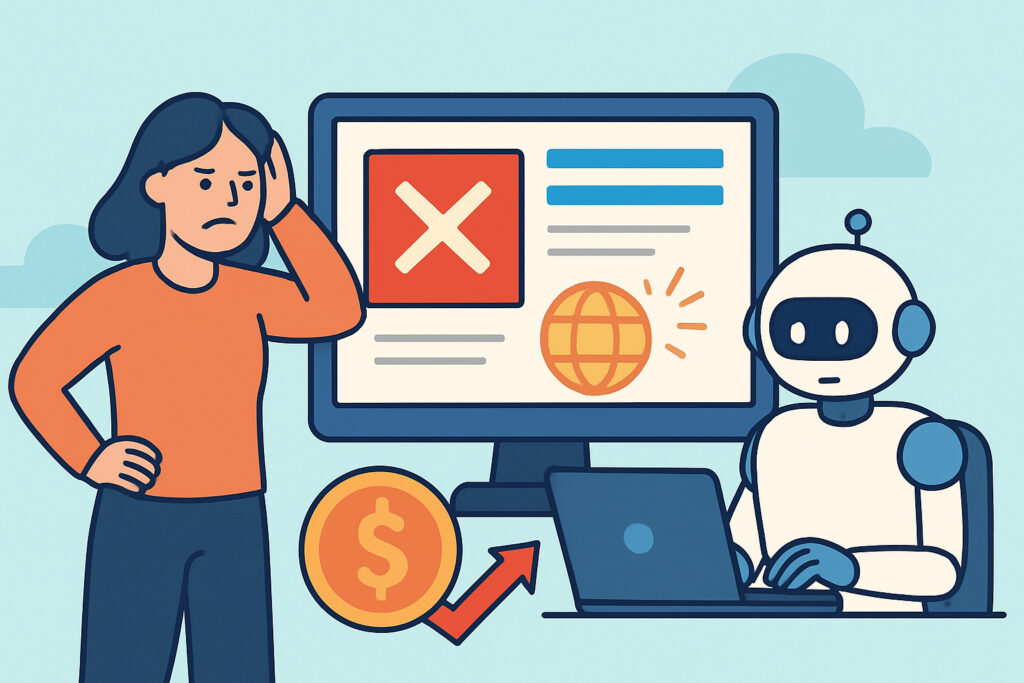
Marketing managers burning through ad budgets know this pain: campaigns that drain cash without delivering results, all because the creative isn’t connecting with the audience. The true cost of bad ad creative extends far beyond wasted spend – it damages brand perception, kills conversion rates, and forces teams into endless cycles of manual testing that rarely produce breakthrough results.
Poor ad creative typically costs businesses 60-80% more per conversion than high-performing assets. A SaaS company running Facebook ads might spend $150 per lead with generic creative, while competitors using data-driven, personalized ads achieve the same results for $40 per lead. That difference compounds quickly across thousands of impressions.
But the hidden costs run deeper. Bad creative burns through audience segments faster, increases ad fatigue, and trains algorithms on poor performance data. Recovery from these mistakes often takes weeks of budget and time that most growth teams can’t spare.
The Hidden Economics of Creative Performance
Most marketing teams underestimate how creative quality affects their entire funnel economics. When ad creative fails to resonate, it creates a cascade of problems that multiply costs throughout the customer acquisition process.
Poor creative leads to low click-through rates, which increases cost per click across all campaigns. A technology company discovered their generic product demos were generating 0.8% CTR on LinkedIn, driving their CPC to $12. When they switched to problem-focused video creative, CTR jumped to 2.3% and CPC dropped to $4.20 – without changing targeting or budgets.
The impact extends beyond immediate ad costs. Low-quality traffic from poor creative converts poorly on landing pages, inflating customer acquisition costs and skewing attribution data. Sales teams waste time on unqualified leads, while marketing automation systems learn from bad data patterns.
Creative fatigue happens faster with poor assets. Generic stock photos and template-based designs exhaust audience segments within days instead of weeks, forcing constant creative refresh cycles that drain resources and disrupt campaign momentum.
Why Traditional Creative Testing Fails
The biggest myth in performance marketing is that more creative testing automatically leads to better results. Most teams run A/B tests without understanding what actually drives creative performance, leading to random iterations that waste time and budget.
Traditional testing approaches test surface elements – colors, headlines, images – without addressing deeper issues like message-market fit or emotional triggers. A B2B software company might test five different headline variations while completely missing that their core value proposition doesn’t address their audience’s primary pain points.
Sample sizes kill most creative tests before they start. Teams launch tests with insufficient traffic to reach statistical significance, then make decisions based on incomplete data. This leads to false winners that perform poorly when scaled, creating expensive mistakes that compound over time.
Sequential testing slows everything down. Testing one element at a time means it takes months to optimize a single campaign, during which market conditions, audience behavior, and competitive landscape all change. By the time results arrive, they’re often irrelevant.
How AI Transforms Creative Development and Testing
AI approaches creative optimization differently by analyzing patterns across massive datasets to predict performance before ads go live. Instead of guessing what might work, AI systems identify creative elements that historically drive results for similar audiences and objectives.
Modern AI creative tools analyze thousands of data points – visual composition, messaging frameworks, emotional triggers, timing, and audience characteristics – to generate creative assets optimized for specific campaign goals. These systems don’t just create variations; they understand why certain combinations work.
Multivariate testing becomes practical with AI automation. Instead of testing one element at a time, AI can simultaneously test dozens of creative combinations, identifying winning patterns in days instead of months. A fintech startup used AI-powered creative testing to find their optimal combination of testimonial style, CTA placement, and background color within 72 hours of launch.
Dynamic creative optimization takes this further by automatically adjusting creative elements based on real-time performance data. AI systems swap out underperforming headlines, images, or CTAs without pausing campaigns, maintaining momentum while continuously improving results.
Implementing AI Creative Optimization
Start by auditing existing creative performance to establish baselines. Export performance data for all creative assets from the past 90 days, including CTR, conversion rate, cost per conversion, and audience engagement metrics. This data becomes training material for AI systems.
Set up proper tracking before launching AI creative tools. Creative-level tracking requires utm parameters, pixel integration, and conversion attribution that connects ad creative to final business outcomes. Without clean data, even sophisticated AI systems produce unreliable results.
Begin with template-based AI creative generation rather than fully custom assets. Tools that create variations of proven creative frameworks typically deliver faster wins than experimental approaches. A marketing agency saw 35% improvement in client ad performance by using AI to customize proven templates for different audience segments.
Implement progressive testing cycles. Start with AI-generated creative variations for existing campaigns, measure performance against current assets, then gradually increase AI involvement in creative strategy and development. This approach reduces risk while building confidence in AI-driven results.
Measuring True Creative ROI
Track creative performance beyond immediate ad metrics to understand full business impact. Creative quality affects email signup rates, demo request quality, sales cycle length, and customer lifetime value – metrics that traditional ad reporting often misses.
Calculate creative efficiency ratios by comparing creative development time and cost against performance improvements. AI-optimized creative might cost 40% more upfront but deliver 200% better conversion rates, creating substantial net positive ROI within weeks.
Monitor creative longevity as a key performance indicator. AI-optimized creative typically maintains performance 2-3x longer than manually created assets because it’s designed around sustainable audience engagement patterns rather than short-term attention grabbing.
Track competitive creative analysis to understand market positioning. AI tools can monitor competitor creative performance and identify gaps in messaging or visual approaches that create opportunities for differentiation and improved performance.
Common Implementation Mistakes
Over-automation kills creative effectiveness when teams rely entirely on AI without human strategic oversight. AI excels at optimization and variation, but brand voice, strategic positioning, and creative vision still require human input to maintain authenticity and market relevance.
Insufficient data integration limits AI performance when creative systems can’t access customer data, sales outcomes, or broader marketing performance metrics. AI-driven advertising platforms work best when connected to complete customer journey data.
Ignoring brand guidelines creates consistency problems when AI generates creative that performs well but conflicts with established brand identity. Set clear parameters around visual style, messaging tone, and brand positioning before implementing AI creative tools.
Short-term thinking undermines AI creative optimization when teams expect immediate results or abandon systems too quickly. AI creative performance improves over time as systems learn from more data, requiring patience and consistent implementation to achieve best results.
Frequently Asked Questions
How long does it take to see results from AI creative optimization?
Most businesses see initial improvements within 2-3 weeks of implementation, with significant performance gains typically appearing after 30-45 days of data collection. AI systems need time to analyze performance patterns and optimize based on your specific audience behavior and campaign objectives.
Can AI creative tools maintain brand consistency while optimizing performance?
Yes, when properly configured with brand guidelines and approval workflows. Modern AI creative platforms allow detailed customization of visual elements, messaging tone, and brand compliance rules. The key is setting clear parameters upfront and maintaining human oversight of brand-critical assets.
What’s the typical ROI improvement from implementing AI creative optimization?
Most businesses see 25-60% improvement in cost per conversion within 60 days, with top performers achieving 100%+ improvements. ROI varies significantly based on current creative quality, industry, audience size, and implementation approach. Companies with previously poor creative performance typically see larger gains.
The Strategic Advantage
The businesses winning with AI creative optimization understand it’s not just about better ads – it’s about building systematic competitive advantages in customer acquisition. While competitors manually test creative variations, AI-powered teams continuously optimize across dozens of variables simultaneously.
This creates compound advantages over time. Better creative performance generates more customer data, which improves AI optimization, which creates even better creative, building momentum that becomes increasingly difficult for competitors to match. The true cost of avoiding AI creative optimization isn’t just current inefficiency – it’s the expanding gap between your results and what’s becoming possible in modern performance marketing.